


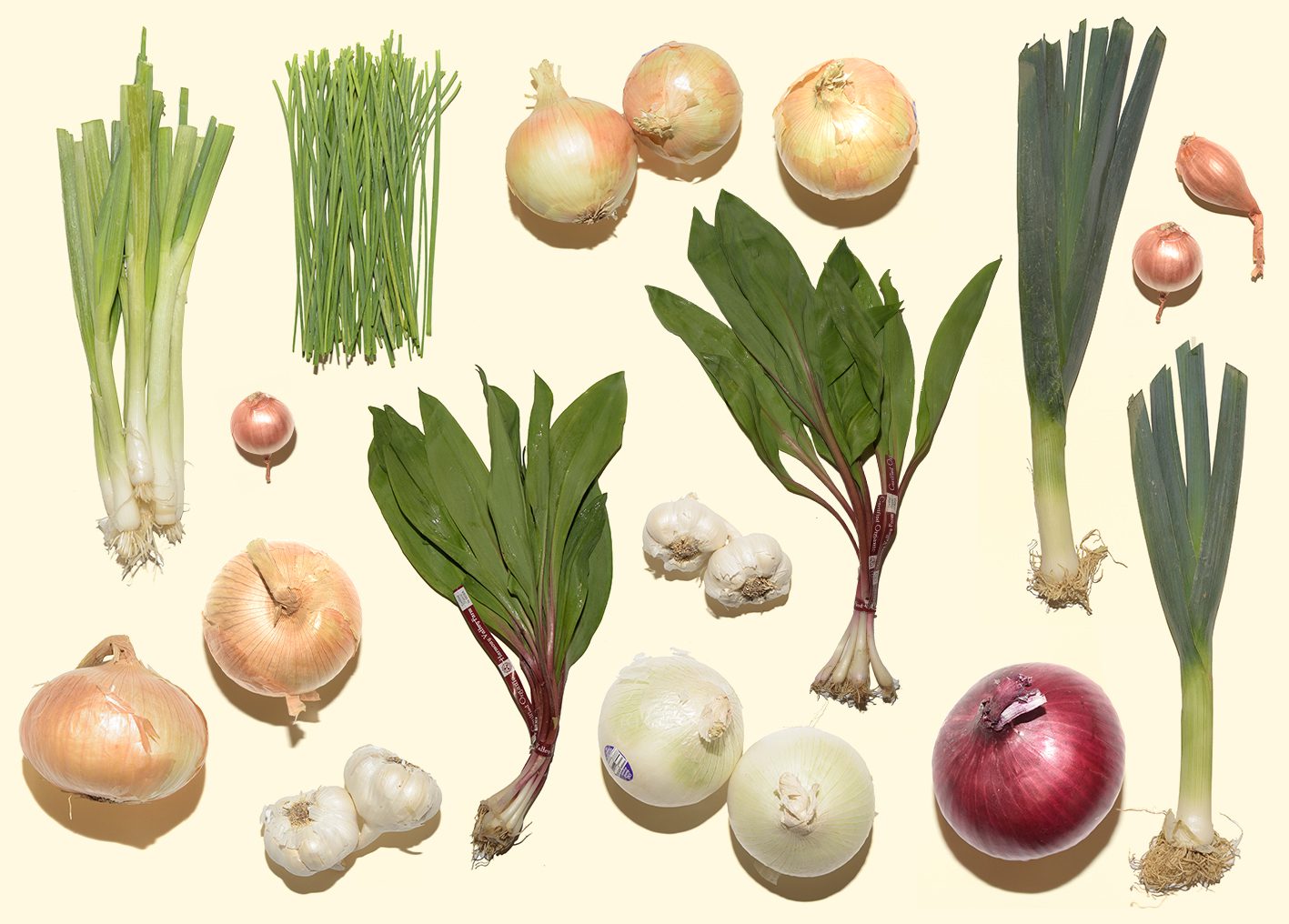
At Breadroot Co-op, we carry a wide variety of edible alliums — the flavorful plant family that includes many of the kitchen staples we reach for every day. From chives and scallions to leeks, shallots, onions, garlic, and even ramps during their fleeting spring season, alliums bring depth, brightness, and aroma to countless dishes. After a long winter of hearty cooking, spring alliums shine with fresh, herbaceous flavors that feel right at home in the season’s kitchen.
While alliums share the savory backbone of onion and garlic, each variety has its own personality: some are sharp and punchy, others sweet, delicate, or grassy. Whether roasted, sautéed, grilled, or enjoyed raw, these versatile vegetables can generally be divided into two groups: root alliums and fresh alliums. Let’s dig in and get to know them a little better.
FRESH ALLIUMS:
Chives
WHAT ARE THEY?
Chives are a popular culinary herb and the smallest, most delicate member of the Allium family. They are easily identified by their thin, dark green, hollow, grass-like leaves and their edible, pale purple blossoms.
HOW DO THEY TASTE?
Chives offer a very mild, fresh, and slightly sweet onion flavor without the sharp, pungent bite of a standard raw onion.
HOW CAN I EAT THEM?
Because their delicate flavor is easily lost to heat, chives are almost always used raw and added as a final touch right before serving. Chives are good on just about anything. Their flavor pairs well with any savory dish; however, they tend to wilt easily if you add them to a dish too early.
Green Onion (a.k.a. scallions)
WHAT ARE THEY?
Green onions (sometimes called scallions or spring onions) are simply the immature young shoots of regular bulb onions (yellow, white, red—it doesn’t matter).
HOW DO THEY TASTE?
Green onions are one of the easiest ways to add fresh onion flavor without overpowering a dish. . Because they are harvested young, they provide a much gentler and crisper bite than mature onions without the lingering, sharp pungency.
HOW CAN I EAT THEM?
Every part is usable minus the roots at the bulb. They’re highly versatile, you can use the firmer white and light-green bases for cooking to release their sweet onion flavor, or use the darker tops as a fresh, crisp garnish. They’re even great grilled whole as an accompaniment to a steak. The sky is the limit.
Leeks
WHAT IS IT?
Leeks straddle the line between an aromatic and a fresh vegetable. Leeks have a similar nutritional profile to their oniony cousins, but they’ve got more vitamins and minerals. They are an excellent source of vitamin A, vitamin C, and folate. Leeks are also high in vitamin K, a nutrient usually associated with dark, leafy greens.
WHAT DOES IT TASTE LIKE?
Leeks taste like a milder, smoother, and sweeter version of a standard onion or green onion. They offer a delicate, slightly buttery, and earthy onion flavor that is much less sharp or pungent than their traditional onion relatives.
HOW CAN I EAT IT?
Whether you’re using them whole, halved, or thinly sliced, leeks need a thorough rinse beforehand. Sand and dirt get caught between leeks’ layers as they grow. Once clean, sauté them in butter or olive oil, add them to soup, or roast or grill them. Once cooked, the stalks have a melt-in-your-mouth consistency, and green tops can be saved for your next vegetable stock.
Ramps
WHAT ARE THEY?
Ramps are a classic allium with a cult following. They’re sometimes referred to as wild leeks or wild garlic, and are a sought-after spring favorite with a short season. Ramps at the Co-op are our true sign of spring, and because they have a very short season, they feel like an exclusive drop. Ramps are a seasonal turning point that promises the produce section is about to get exciting again, after a long winter of root vegetables.
WHAT DO THEY TASTE LIKE?
Ramps have a bold, garlicky flavor with oniony sweetness. The bulbs are more pungent, while the leaves are slightly milder and more delicate. Raw ramps have a sharp bite with an almost spicy, earthy flavor.
HOW CAN I EAT THEM?
Ramps are the gorgeous, perfect little cousin of the onion, so use them anywhere you might use other alliums. Turn them into pesto, create a compound butter, or keep the season going a little longer by pickling them. Dehydrate ramps, and create a ramp-salt, or add them solo to rice, pastas, broths, and stocks.
ROOT ALLIUMS:
Garlic
WHAT ARE THEY?
Garlic grows underground in the form of a bulb. (Its long green shoots produce flower stalks called garlic scapes, which we don’t carry at the Co-op, but in-season you can get lucky and find them at the Black Hills Farmers Market!) Covered in an inedible papery skin, the bulb, or head as it is more often referred to, is comprised of individual sections called cloves, and there can be anywhere from 10 to 20 cloves per head. These cloves are themselves enclosed in a paperlike skin, which needs to be removed, and the pale yellowish flesh within is the part of the garlic that is used in cooking and can be cut in a variety of ways.
WHAT DOES IT TASTE LIKE?
When eaten raw, garlic has a powerful, pungent flavor. For that reason, it’s customary to cook it in some way before serving it, which mellows the flavor considerably. Roasting garlic changes the flavor and texture significantly, resulting in creamy cloves with a nutty, mild taste.
HOW CAN I EAT THEM?
As garlic is one of the most popular ingredients in cooking, there are endless recipes including garlic. Chop it up and use it as an aromatic base in almost any dish, leave cloves whole and roast or confit them as a flavor-dense topping. You can even use it medicinally, as it contains allicin, which act as a strong antioxidant and antimicrobial.
Yellow Onion
WHAT ARE THEY?
The yellow onion is the ultimate all-purpose, go-to cooking onion, making up nearly 90% of all storage onions grown. They have a firm texture, papery yellow-brown skin, and white flesh.
WHAT DO THEY TASTE LIKE?
Yellow onions offer a robust, complex balance of sharpness and sweetness. When raw, they are highly pungent, sharp, and slightly astringent. When cooked, their sharp bite mellows out, yielding a deep, savory sweetness and buttery flavor that is ideal for caramelizing.
HOW CAN I EAT THEM?
Yellow onions are your culinary workhorse. Their balance between sharp and sweet can add to so many dishes. Yellow onions have a bold flavor and hold their shape better when cooked than white onions, making them great when you want a more pronounced onion flavor and texture. They’re best used as the aromatic foundation for savory dishes or caramelized.
Sweet Vidalia Onion
WHAT ARE THEY?
Vidalia onions are a type of sweet onion that originated in Georgia. They got their name from tourists who purchased the onions at the Vidalia Farmers’ Market in Toombs County. You can identify a Vidalia onion by its uniquely flat shape, golden brown exterior, and white interior.
WHAT DO THEY TASTE LIKE?
Vidalias have a distinct sweet and crisp taste and are a favorite among chefs because of their versatility. They have a sweeter taste because of their high water and natural sugar content, compared to other yellow onions which have a milder taste when cooked.
HOW CAN I EAT THEM?
Like most onions, Vidalias are incredibly versatile and work well in a wide range of dishes. They bring a depth of flavor that’s hard to beat. Their natural sweetness makes them a go-to for caramelizing and other low-and-slow recipes, but they’re also delicious raw or lightly grilled, adding flavor without overpowering the other ingredients.
White Onion
WHAT ARE THEY?
White onions have a papery white skin and flesh to match. Their water content is higher than other onion varieties, which gives them a juicy crunch.
WHAT DO THEY TASTE LIKE?
White onions have a sharper, more distinct onion flavor than yellow varieties. They tend to have a cleaner, crisper, and firmer texture, with a slightly brighter taste when raw and little to no aftertaste.
HOW CAN I EAT THEM?
When used raw, they can add some texture to sandwiches and burgers or in Mexican cuisine. Though they’re great raw, white onions can hold up in other methods of cooking too. They can serve as a substitute option for yellow onions in most recipes.
Red Onion
WHAT ARE THEY?
Red onions, sometimes called purple onions, are a smaller onion variety with a burgundy papery skin and tinged flesh that matches it’s bold bite.
WHAT DO THEY TASTE LIKE?
Peppery and a little spicy. They are the most pungent of all the onions, packed with bright, peppery spice that, if eaten raw, lingers long after the meal.
HOW CAN I EAT THEM?
Red onions are a natural choice for any recipe that calls for raw onions. If you want to cut their bite, throw them post-prep in an ice bath or refrigerate in water overnight. They’re also great pickled as a garnish. Quartered, you can roast or grill them, and their layers will char up and while their insides get jammy and sweet.
Shallots
WHAT ARE THEY?
Shallots look like smaller, slightly elongated onions. They have thin, papery, purplish-brown skin, but on the inside, they are close in color to a red onion. When you break open the skin of a shallot, you will notice that they often divide into cloves, like a head garlic.
WHAT DO THEY TASTE LIKE?
Shallots often are described as a cross between a red onion and a white onion. They strike just the right balance of spicy and sweet. Their flavor tends to be milder and sweeter than onions, yet still pungent, and for this reason, is a favorite ingredient among chefs.
HOW CAN I EAT THEM?
Shallots are one of the more versatile ingredients you’ll ever come across. They can be gently sautéed, roasted, or fried for a crisp topping. You can pickle them to cut their natural heat, but unlike onions, shallots are delicious raw and work well in salads, sandwiches, and vinaigrettes.